❋
Feeding your dog the home-cooked way.

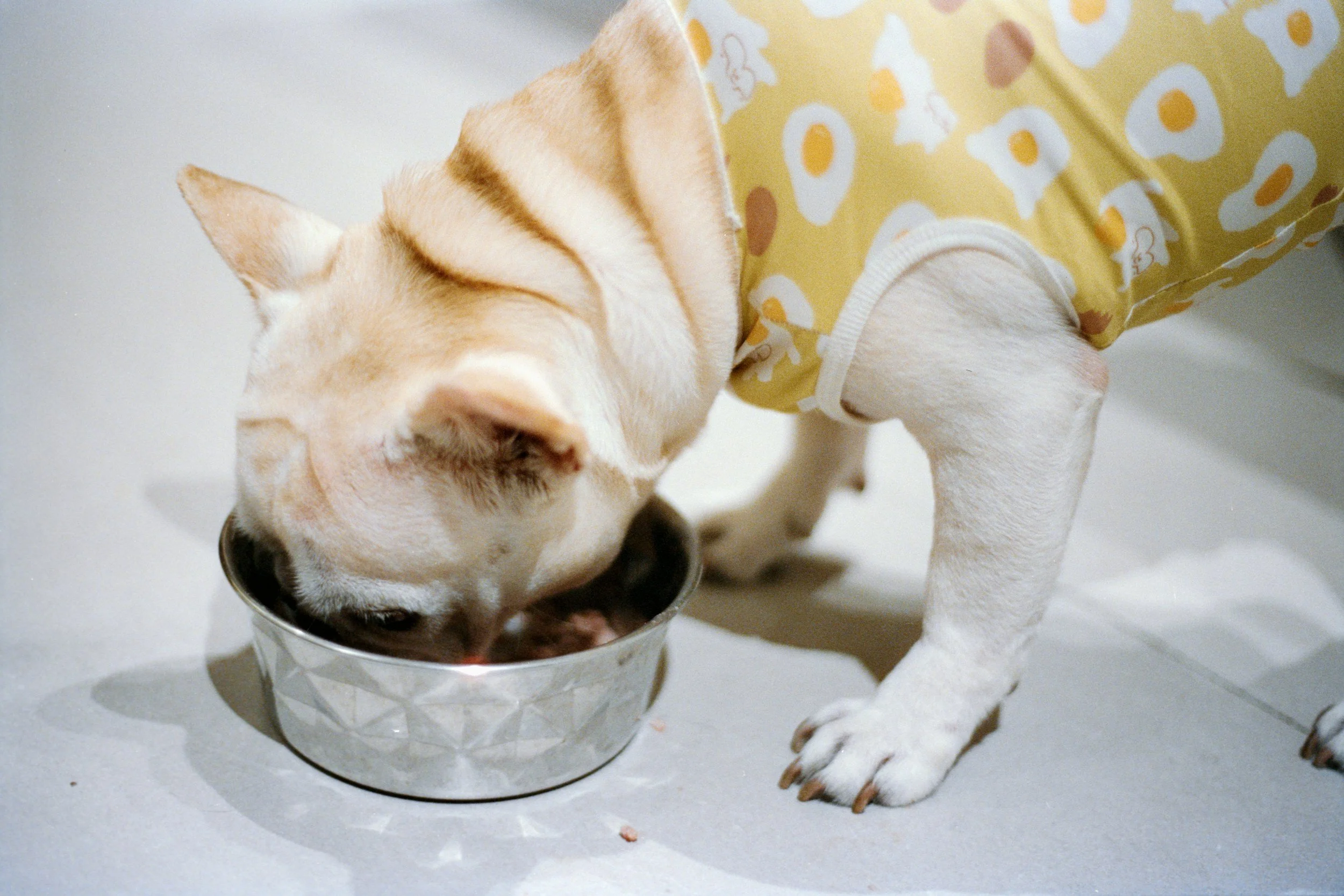
The food that goes into your dog’s bowl is supremely important. Imagine a world where you were required to eat highly-processed, dried, uniform shaped and flavoured, tan-coloured dog food that has a shelf-life of basically forever? Twice a day for the rest of your life! How healthy do think you would be? What about your mental state and your enjoyment of food? A chocolate labrador can consume or inhale a bowl of this kibble in such a short moment that no wonder he is immediately looking for the next bowl of food. He hasn’t needed to chew, rip or tear or any of the actions which induce satiety.
It is so important to do whatever we can to move our companion’s food towards a more natural and unprocessed bowl. For some this will be simply topping off the regular food with some cooked meat or offal, or perhaps some yogurt. But even better if we can move over to a fully fresh, grain-free and unprocessed diet.
I will be writing a blog soon about raw feeding and it’s advantages. But today I want to talk about another excellent option for feeding;
home-cooked fresh dog food.
Firstly, just understand that it is straight-forward for you to cook for your dog. Once you have understood a couple of important rules, the fact is the most important lesson is to provide variety over time. Notice I’m not saying that your dog needs variety every day. It is (usually) impractical to cook a bespoke morning and evening meal with different ingredients each time, and furthermore it is unnecessary. It is perfectly healthy to cook one batch of chicken and feed it for several days on the trot before swapping over to beef. Batch cook and freeze in portions to make this routine as simple as possible. Consider your own convenience and make the diet fit around your own requirements. Aim to achieve variety over the course of a month.
Two things before I start. I’m talking here about healthy dogs, if you have a pet with an ongoing medical condition then speak to your (holistic)vet and get a specific diet plan in place to accommodate the condition. Bear in mind that for dogs with allergies or sensitive stomachs, I would be getting a holistic, fresh diet sorted out ASAP.
And secondly, be aware that cats are different and have particular needs in terms of diet - this blog is not about cats.
Non-negotiable rules.
1/ The Calcium:Phosphorus ratio.
The proportion of calcium to phosphorus is especially important when it comes to healthy bone growth. Failure to give adequate of either of these vital minerals can lead to problems, but their proportion relative to each other is particularly critical. They need to be given at a 1:1 ratio to each other. Phosphorus is abundant in meat, so no need to supplement assuming you are following my recommendations for a basic recipe. It is essential, however, that you supplement the calcium in a home-cooked diet in order to achieve the correct ratio.
To do this you need to add 2g of supplemental calcium per kg of food as it is fed: meaning in its wet form (as apposed to calculating on the basis of dry matter). It is important that you use either calcium carbonate, calcium citrate or a ground egg shell powder, since other supplements may also contain phosphorus, throwing your ratio out and causing you a mathematical headache. Notice we supplement the food, not the dog: calcium dose doesn’t depend on the dog’s weight unlike other supplements, it depends on the weight of the food; we are getting the proportion correct in the food itself. The takeaway from this paragraph is 2g of supplemental calcium per kg of food.
2/ Include the cooking water
Some of the best bits in the ingredients you are using are lost into the cooking water. Retain all those lovely extras by mixing the liquid portion thoroughly into the food before freezing in portions. This is particularly important for taurine.
3/ Use a high-quality balancing supplement
I love to use Aniforte Canine Complete because it is excellent, covering the big headline vitamins and minerals using natural ingredients. I sell it because I consider it to be the best. By using this supplement and an egg shell powder I know I’m ticking all the micronutrient boxes, and I can get on with the fun part; throwing a variety of beautiful, wholesome food together.
Now for the fun bit of actually putting the food together.
So you’ve got your ground egg shell powder and your Aniforte Canine Complete, it’s time to make the food.
I like to make things easy for myself so I mainly deal with minced meat: turkey, chicken, lamb, beef, venison, low fat pork mince. Heart also counts as the ‘meat’ part of the diet (as opposed to the offal element) so I suggest checking with your local butcher for ox heart now and again as its great value and very nutritious. The ‘meat’ part of the food should make up 50% - if we’re making a kilo of food (for ease of calcium supplementation) then that’s 500g. Offal and other toppings should make up another quarter of the food, 25%, 250g in this example. These toppings can include, on rotation: liver, kidney, sardines, cottage cheese, egg, yoghurt, kefir. I will throw offal and eggs into the pre-cooked food, whereas those items that don’t need cooking can be added afterwards once the batch has cooled. You could also keep the eggs raw if you fancied it, its totally up to preference. Finally comes the veg and fruit portion: 250g, 25%. Make the majority up with low sugar items: spinach, cabbage, cauliflower, parsnip, courgettes. A handful of blueberries is great, not too sweet and some vitamins and anti-oxidants that are difficult to get elsewhere. I pick a load of wild blackberries to store in the freezer to add to the food for an anti-oxidant power-push throughout the year. I would include the fibrous veg in the pre-cooked food to tenderise it, whereas berries, grated carrot or beetroot I would add to the cooled product.
I can’t emphasise enough how much I keep this very simple for myself. So an example of a batch (I would do 2kgs at a time and freeze in portions) is as follows:
50% beef mince
25% lamb kidneys, sardines, a couple of eggs
25% diced parsnip, chopped kale, chopped cauliflower and a handful of blackberries
Supplements: Ground egg shell 5.26g/kilo of food. (2g of which is calcium)
Aniforte Canine Complete as per the packet instructions.
So I throw the mince, the chopped kidneys, the diced parsnip, kale and cauliflower and the eggs into the instant pot pressure cooker. Pressure cookers are ideal as the nutrition of the food is retained better due to a shorter cooking time. A slow cooker is fine, but absolutely remember to retain that lovely cooking water. I will now add some water to the instant pot, just enough to cook the meat as I don’t want the food to be too wet.
My pressure cooker will cook this perfectly set at 2 minutes cooking time. I will then let the mixture totally cool, give it a good stir and add the sardines, blackberries and supplements. I will then divide it into takeaway-style containers and pop them in the freezer to defrost each day.
To work out how much food to give your dog calculate 30g food per kilo (of dog) per day, which takes account of the water, and then judge their weight over time. The perfect weight is when you can feel the last two ribs easily without any pressure, but the rest of the ribs have a slight ‘covering’.
The next week I might create a batch based around turkey mince, liver and yoghurt and the following week a venison-based batch. Variety is everything!
I hope this helps you to get started with home-cooking. Stick to the three non-negotiable rules and you’ll soon get into the swing of things.
Nothing in this blog is intended to replace advice from your own vet who knows your actual dog. Please contact them if you are concerned about your pet’s health and follow their advice. But also bring in a holistic vet to your veterinary team, they will usually work on referral from your primary care vet. Please by all means get in touch for an appointment.